Mao + Chris
Mao (Kun) Chen + Chris Savage


Flaws to Forms
By Mao and Chris
"Flaws to Forms" is a research report developed during the Public Art for Sustainable Futures residency with Calgary Arts Development. Over four months, Mao and Chris explored how broken and unsellable ceramics—often seen as waste—can be creatively reused in sustainable ways within public art and studio practices.
Introduction
Over the past four months, during our Public Art for Sustainable Futures Residency with Calgary Arts Development, we’ve been researching and conducting material tests in our ceramics studio to explore how broken and unsellable ceramics can be repurposed at various stages of the ceramic process. Our collaborative research was deeply informed by the residency’s focus and the opportunity to learn from peers in this year’s cohort.
This experience was unique in its emphasis on research rather than production, with a focus on public art, sustainability, and our local context. One key realization that emerged was how interconnected these three themes are—and how necessary it became to approach them as a unified framework for our planning and inquiry.
The outcomes of this report are not exhaustive, but rather a starting point—a measured point of departure that will guide us as we continue developing future projects. Our goal is to expand our understanding of ceramic materials and how they can be creatively and responsibly reused in the context of public art.
Through this report, we aim to share our research findings and some of the technical tests we conducted. Given the nature of the medium, we believe this work is critical for making our practice more sustainable while opening new possibilities for public art.
Context for New Beginnings
For the past five years, our lives have revolved around clay. Our main focus has been our ceramic art and design studio, Mao Projects, which we founded in the aftermath of the pandemic and have continued to grow since.
We’ve always struggled to discard these “failures.” Even when broken or cracked, the objects held a sense of potential—something unresolved but still present. Over the years, these flawed works collected in a corner of our studio, eventually spilling over and demanding our attention. We also noticed during residencies and studio visits that this accumulation of fired waste is a common problem among ceramic artists.
As storage space dwindled, it became clear that we needed a creative solution. Mosaic became our first area of exploration—an approach where we could work with the material as it exists (or with minimal transformation), breaking pieces down just enough to recompose them into something new. This process was not only practical but symbolic, offering a way to engage with the materials’ existing form and history.
As we delved deeper, we began discovering other ways that fired ceramic waste is being reused and transformed. While the list in this report is by no means comprehensive, it reflects some of the most promising and accessible methods we’ve encountered—ones we plan to build upon through further experimentation.
Land Acknowledgement and Material Responsibility
It feels important—both within the context of the Public Art for Sustainable Futures residency and in our ongoing practice—to acknowledge the land we work on and the materials we work with. We are grateful guests to this land, and as such, bear a responsibility to protect and use wisely that which we take from it. The clay we use is mined from along the South Saskatchewan River near Medicine Hat, and many of our raw materials are sourced from mines across North America.
By the time these materials arrive at our studio, they’ve already undergone highly extractive processes—processes that permanently alter the landscapes they come from. This weighs heavily on us. It compels us to be intentional with how we use these resources and minimize waste as much as possible.
And yet, even with great care, ceramic failure is unavoidable. Sometimes, nothing can be done to save a piece. This reality has shaped our belief that there is a responsibility to treat all materials with respect—even those that can no longer fulfill their original purpose.
Approaches to Reuse
There are many approaches to reusing flawed or broken ceramics—ranging from high-energy processes that return ceramics to raw material form, to minimal-intervention methods like mosaic. In this report, we focus on three approaches that show particular promise for public art contexts:
-
Complete breakdown into powder, to be reintroduced into raw clay.
-
Partial breakdown for reuse in tiles or bricks.
-
Mosaic process, requiring minimal transformation.
Each method offers different strengths, depending on factors like time, scale, and location. In some cases, a combination of methods may be the most effective solution.
An important consideration when choosing a reuse method is volume. In areas with large-scale ceramic production, methods that involve full material transformation make more sense—they can be reintroduced into the industrial cycle. Most of the large-scale examples we studied take place in regions with long ceramic histories, where industrial waste has been accumulating over decades or even centuries.
In contrast, large-scale ceramic production in Southern Alberta largely ended with the closure of factories like IXL Bricks, Medalta, and Highcroft. While these industries once operated on a significant scale, today’s ceramic waste comes primarily from studio and small-batch practices like our own. This makes reuse in artist-led, community-oriented, and low-tech formats all the more relevant.
Complete Breakdown
One of the most innovative and inspiring examples of ceramic reuse can be found in the Mino region of Japan, a place with over 1,300 years of ceramic history. Known for producing Oribe, Shino, and Seto-style wares, Mino is a global centre for ceramic production—and, unsurprisingly, also faces the challenge of ceramic waste accumulation on a massive scale.
In response, producers and researchers in the region have developed a circular recycling process that reintroduces fired ceramic waste back into the raw clay supply. Rather than discarding flawed or broken wares, local facilities collect these materials and crush them into a fine powder using industrial grinders. This powdered material—often referred to as sai-hai—is then carefully blended into new clay bodies.
This process allows for a closed-loop system that reduces the need for virgin material extraction while giving new life to what would otherwise be landfill waste. The integration rate of recycled ceramic powder into raw clay varies depending on the type of clay and its intended use, but tests show that it can replace a significant portion of new material without compromising the workability or structural integrity of the clay.
Beyond its technical success, the Mino region's approach is a compelling example of systems-level thinking within a deeply rooted craft tradition. It combines industry knowledge, regional cooperation, and sustainable innovation—demonstrating what’s possible when legacy craft communities adapt to environmental realities.
While the scale of this initiative is much larger than anything we currently see in Canada, it offers an important model. It shows how cultural heritage and environmental stewardship can coexist through thoughtful material innovation. It also raises the question: how might similar systems be adapted to smaller studio contexts like ours, or scaled to meet the needs of contemporary public art projects?
Partial Breakdown
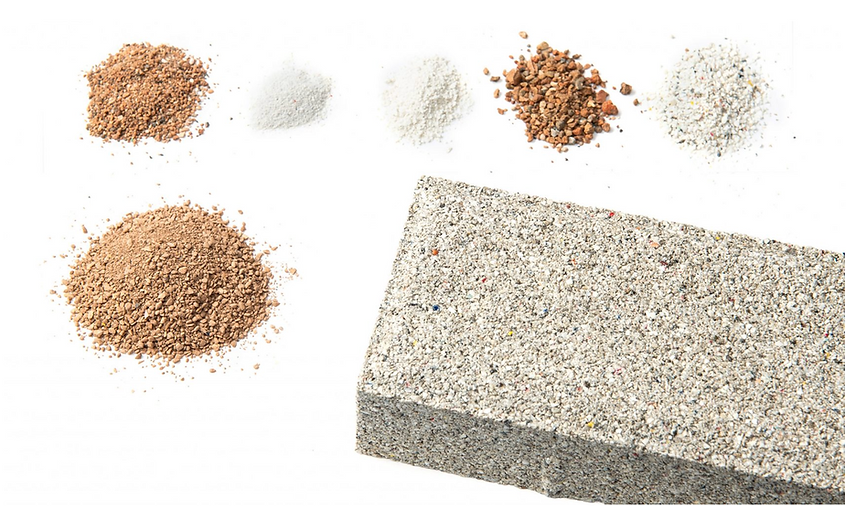
In recent years, local designers and makers have begun to reimagine this “waste” as a resource. One of the most exciting examples is Yi Design Group, a design studio based in Jingdezhen that has developed innovative methods for repurposing broken ceramic pieces into gravel and tile-based products.
The process begins with the collection of flawed or discarded porcelain and stoneware from nearby factories and studios. These materials are then broken down into irregular gravel-like fragments, which can be sorted by size and texture. The fragments are used in several ways—most notably as aggregates for terrazzo-style tiles, gravel for landscaping, and as embedded decorative elements in architectural cladding.
Yi Design Group treats each broken shard not simply as scrap, but as a material with embedded cultural and aesthetic value. The resulting products are designed for architectural and design applications, bringing ceramics—historically used for functional wares—into conversation with urban and environmental space.
Unlike some industrial approaches that seek to erase all traces of the material’s prior life, this method celebrates imperfection and visible fracture. The surfaces of the finished tiles often retain glimpses of glaze, pattern, or form from the original pieces, offering a layered history within each object.
This practice is especially significant in the context of Jingdezhen’s long history of production. As the city has evolved from imperial kiln site to global porcelain exporter, it has struggled with the environmental impacts of mass production. By developing methods to reintegrate flaws into architecture and design, studios like Yi Design Group offer a way forward—bridging tradition and sustainability.
For us, this model is particularly inspiring in its low-tech adaptability and strong visual language. It prompts us to consider how ceramic fragments can function not only as raw material, but also as narrative carriers—visually connecting place, process, and history through public-facing design.
Mosaic Process
What makes this site particularly notable is its scale and visibility. Unlike more discreet or industrial reuse methods, the Porcelain Palace foregrounds waste—turning what would typically be hidden or discarded into a monumental expression of cultural pride and material reverence. The aesthetic impact is both maximalist and immersive; viewers are surrounded by layers of ceramic history, transformed through labor-intensive and highly tactile mosaic work.
This project shows how the mosaic process can operate at a public scale, transforming vast quantities of flawed material into something both visually striking and communally meaningful. It requires little to no industrial intervention—the ceramics are used nearly as-is, broken into fragments and embedded into cementitious substrates. This low-tech approach makes it widely adaptable, particularly for artist-led or community-driven projects.
Conclusions and Future Plans
This residency provided us with the rare and valuable opportunity to focus purely on research—something that is often difficult to prioritize within the daily demands of production. Stepping back from making allowed us to ask deeper questions about our materials, processes, and responsibilities as ceramic artists working in a time of ecological urgency.
While one of our original goals was to begin developing a network of local studios to collect ceramic waste, we quickly realized that the methods available for reuse required more investigation than we had initially anticipated. The technical and logistical complexities of repurposing fired ceramics—whether through grinding, mosaics, or architectural reuse—demand a strong foundation of research and experimentation. This residency gave us the space to do that essential groundwork.
Instead of immediately scaling outward, we chose to turn inward and focus on our own studio systems. We used this time to explore how we could build a more circular design process within our existing practice—where materials are not simply consumed and discarded, but thoughtfully repurposed and reintegrated into new forms. This shift in perspective has been both clarifying and energizing, and it has allowed us to reimagine the role of failure and waste in our creative process.
We are incredibly grateful to Calgary Arts Development and the Public Art for Sustainable Futures program for supporting this phase of research. Moving forward, we are developing plans to connect with other Southern Alberta studios to begin a regional collection system for flawed and broken ceramics. Our goal is to expand this work into a longer-term public art initiative that highlights sustainable material practices, fosters collaboration, and transforms waste into something both meaningful and shared.
This is just the beginning. The fragments we’ve gathered—both literal and conceptual—will continue to guide us as we shape what comes next.


Specializing in functional wares—mugs, plates, spoons, and more—we’ve built a business that supports our livelihood while continuing our artistic practice. Early viral success online allowed us to step away from teaching roles and dedicate ourselves to full-time production, selling our work to an international audience online and through markets across North America.
Through this experience, especially through the logistics of production and shipping, we’ve come to intimately understand the limitations of ceramics—particularly their fragility. Over time, we accumulated many pieces that didn’t survive the transformation from raw clay to finished object, or that were damaged in transit. While unfired clay can often be reclaimed, once a piece is fully vitrified, it becomes geologically permanent—resistant to natural breakdown.


Dezeen / Yi Design, "Yi Design creates permeable bricks using ceramic waste," 2023.
Source: https://www.dezeen.com/2023/11/28/yi-design-permeable-yibrick-materials/

In Jingdezhen, often referred to as the “Porcelain Capital” of China, ceramic waste is both deeply visible and historically entrenched. With over a thousand years of continuous porcelain production, the city is filled with what locals call “porcelain mountains”—piles of discarded shards and broken ware that have accumulated over centuries. In this context, ceramic waste is not just a byproduct, but a defining feature of the landscape.

While many approaches to ceramic reuse focus on reintegration into new functional objects, mosaic offers a more direct and materially faithful method of transformation—one that celebrates the surface, the fragment, and the story embedded in every shard. A compelling and ambitious example of this can be found just outside Jingdezhen, in the form of the Porcelain Palace (also referred to as the China Porcelain House or “瓷宫”).
Constructed almost entirely from discarded ceramic materials, the Porcelain Palace is a large, mosaic-covered structure that functions both as a monument to Jingdezhen’s porcelain heritage and as a public art landmark. Its walls, roofs, and walkways are completely encrusted with broken plates, bowls, tiles, and porcelain sculptures—many of which are seconds or factory rejects from the region’s prolific production lines.

Importantly, the Porcelain Palace also functions as a tourist destination and educational site, inviting visitors to engage with the legacy of Jingdezhen’s ceramic culture through direct, spatial experience. It becomes a living archive—one that is not preserved behind glass, but rather encountered underfoot and overhead.
For us, the Porcelain Palace is a powerful example of how ceramic waste can be transformed into a public-facing, celebratory space, rather than something to be hidden or discarded. It prompts us to ask: what would it mean to build public art that doesn’t just “solve” waste—but instead elevates it into something monumental, joyful, and enduring.
Add your own content here. Click to edit.